About
About Capsium
Capsium is a project developed by Ribose to provide a common architecture for portable, secure information interchange and unified management.
The Name & Logo
An element of the deployment table
Capsium is a word built from three parts, and each one carries a piece of the architecture.
- caps- — the capsule. A Capsium package is one whole capsule containing an entire website or webservice: content, data, routes, and metadata enclosed whole — self-contained, tamper-evident by design.
- -ium — the element suffix. Like helium or titanium, a Capsium package is an indivisible, fundamental unit — a wholeness unto itself. You deploy it whole or not at all; it is the elemental unit of web deployment.
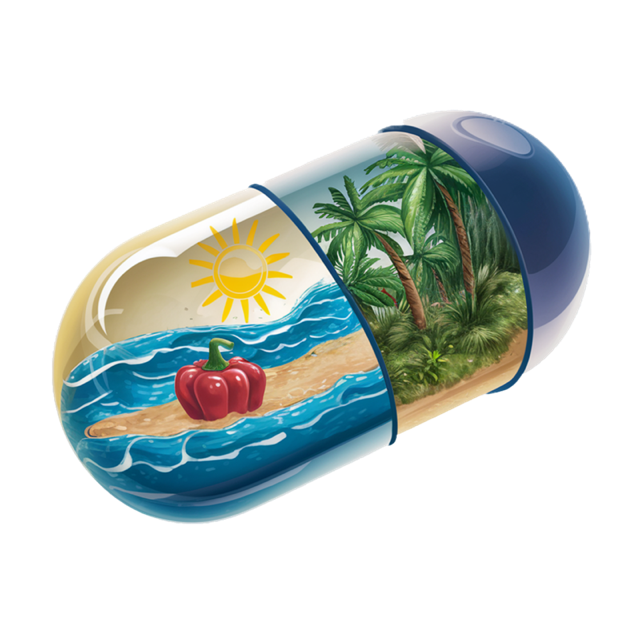
- Capsicum — the pepper genus. A nod to the red bell pepper resting inside the logo's capsule — a little kick inside every package.
The logo makes the idea literal: a translucent capsule containing a tropical beach diorama — sun, surf, palm trees — with a single red bell pepper on the sand. The capsule is the package; the beach is your content — enclosed, portable, provably intact wherever it lands.
The Colors
The palette is drawn straight from the logo — deep teal water, sandy beach, tropical sun, and one very red bell pepper — brightened for screens into the "midnight capsule" theme.
Midnight
#0A1C24
Dark page background
Surface Teal
#12404F
Cards & elevated surfaces
Electric Teal
#22B8D4
Primary actions
Glow Cyan
#4FD1E5
Glow & highlight accents
Pepper Red
#E85D64
Accent — the bell pepper
Sun Yellow
#DAB956
Sunny accents
Sand
#D5B579
Warm highlights
Cream
#EEEBE3
Light page background
Origin Story
Built at Ribose
Capsium was created at Ribose to solve a recurring problem: content deployment should be portable and secure by default, not an exercise in rebuilding the same pipeline for every platform. Capsium packages make content a self-contained, verifiable artifact — pack it once and serve it anywhere.
Mission Statement
Our mission
Our mission is to make content management and deployment easy, secure, and efficient for developers, packagers, deployers, users, and organizations.
The Ecosystem
The project family
| Project | Description | Category |
|---|---|---|
| capsium | The Ruby gem and CLI: pack, inspect, and serve Capsium packages. | Packager |
| capsium-js | TypeScript runtime for Capsium packages, with a service-worker reactor. | Packager |
| capsium-lua | Production reactor for nginx / OpenResty, with Docker images. | Reactor |
| capsium-webextension | Browser extension reactor for Chrome and Firefox — no server needed. | Reactor |
| cap-story | A sample Capsium package to explore and experiment with. | Sample |
| standards | The CC 62001 draft standard defining the Capsium architecture. | Standard |
| capsium.github.io | This website, built with Astro. | Sample |
Use Cases
Where Capsium fits
Static website deployment
Pack a whole site into one .cap file and serve it from any reactor.
Microservices route mounting
Mount package routes into a larger application, consistently across reactors.
Data migration
Move content and datasets between systems as self-describing packages.
Secure interchange
Exchange content with SHA-256-verified integrity and optional signatures.
Version control & updates
Ship explicit versions and dependencies; upgrade without drift.
Open Source
Open by default
Capsium is an open-source project. Every repository is developed in the open under the capsiums organization on GitHub and released under the MIT license. Contributions are welcome — fork a repository and open a pull request.
Get Started
Ready to dive in?
- 1.Install the CLI and verify your setup
- 2.Follow the walkthrough to pack your first package
- 3.Read the specifications behind the format
- 4.Star the repos and join the project on GitHub